Competing Crises:
Disability and the Right to Housing in British Columbia
Meet the Artists
-
![Closeup of What you Don't See, a collage of images showing different homes.]()
Melissa
“What You Don’t See”, “Introspection on Invisible”
When I was invited to participate in this project, I knew immediately that I wanted to create art that fully embraced the lived experience of housing disparity in British Columbia.
-
![Digital art showing five homes, above them from left are fire, tornado, water, a single dollar sign and a triple dollar sign.]()
Holly
“Five Homes”
I hope to one day become an animator and create my own cartoon series for youth and teens. Drawing has always been my thing, and I am starting to share my work publicly. -
![Stained glass house with squares and rectangles of blue, yellow, brown, green and white. The roof is a triangle with a strip of brown on the top right angle.]()
Tayler
“The Plate“, “The Condom”, “The Lottery Ticket”, “The Portable Home”, “The Stained Glass House”, “Foundation”
I’m interested in the tension between vulnerability and power, fragility and resilience. My art is personal and political, and I cannot separate the two. -
![Fountain pen writing script]()
Tara
“The Systemically Dismissed”
As an adult with ASD and ADHD, she brings a unique perspective to learning and creativity, navigating processing challenges while embracing a deep love for writing, music, and sound.
-
![ink and watercolour drawing of a person sitting on a bench with their feet up and their arms wrapped around themselves.]()
Manmeet
“No Place to Rest”
He is passionate about art, human rights, and advocating for the inequalities people face in everyday life. His work explores social issues, power, and access. -
![Charcoal and watercolour on paper, a women's body overlaid by a home, line and the words Heat dome and wildfires.]()
Jewelles
“Holding it All”, “Vacancy, with Conditions”
Smith’s paintings layer vibrant oil colours, images, text printmaking, and found objects on canvas. Currently, she is exploring the meaning of “home” in the context of the housing crisis, climate emergencies, and all the diversity of human experience and need.

About this Project:
This arts-based research project explored the intersections of disability, housing insecurity and climate emergency in the province of British Columbia (BC), Canada. This exhibit explores housing from the perspective of six disabled artists in the province. Represented are both student/emerging artists as well as more seasoned artists. “Competing Crises” is part of a larger Social Sciences and Humanities Research Council funded project that explores the right to housing for disabled people in four provinces.
Methodology
Artists were recruited through networks connected to Procne Navigation and once identified, interested artists met in a Zoom meeting to discuss the project, including how arts-based methods can amplify research and explore concepts in visual and other forms of arts. After the initial discussion, Jewelles met with some of the artists individually to discuss their concepts and support how their ideas could be represented via various mediums.
Seven artists showed interest after recruitment, and six submitted pieces (visual and poetry). The pieces included below represent varying degrees of artist experience, geography, and lived experience of disability. All artists live in British Columbia.
Fostering Community Dialogue
The proposed project seeks to create meaningful conversations that amplify the narratives around disability and housing insecurity, encouraging community members, policy makers, and other interested parties to reconsider their own assumptions. It seeks to amplify the voices found in the Right to Housing for People with Disabilities research project, and to facilitate dialogue about disability and housing rights into the public sphere.
Intersectional Experiences of Disabled Tenants
In addition to the inclusion of rural and remote voices, the project recognizes the experiences of disabled youth, seniors, and Indigenous people in relation to housing rights and the climate crisis, the opioid crisis, along with existing policies and legislation, all create a framework for where and how voices are heard. It is the desire of Procne Navigation to continue to build on these stories and one day have an in person exhibit of art by disabled artists exploring this theme.
Climate Change as a Catalyst
British Columbia has risen as a frightening example of climate change and climate emergencies over the past decade. The province has experienced extreme weather events, including: slides, floods, annual forest fires that devastate the environment, displace cities, and affect air quality; extreme heat events; atmospheric rivers; droughts; and winter events that negatively impact crops and climate. Disabled people are often deeply impacted, even losing their lives in mass events like the heat dome of 2021 during which at least 619 people died.
Housing Crisis and Vulnerability
Concurrent to the above crisis, the province also leads in the current unaffordable housing market. While disabled people are most likely to experience displacement and housing insecurity due to poverty, the climate and housing crises, and other factors including a lack of affordable accessible housing stock, their voices are rarely included in the planning processes in a meaningful and inclusive way.
About the Exhibition
Using arts-based analysis and a/r/tography, artists created mixed-media visual art pieces and poetry exploring the right to housing for people with disabilities in the context of the province’s housing crisis, climate crisis, legislation and policy.
Intended to expand the conversation on housing insecurity and homelessness in British Columbia beyond the borders of the Greater Vancouver Region, the artists reflect on their own experiences to create pieces intended to evoke emotion and spark conversation. These pieces are often personal and engage the viewer in a reflection and hopefully a conversation about what it means to be disabled in BC right now.
Below you can explore this visual exhibition, including reflections written by the artists about each piece.
Further Reading on Arts-based Research
Freire, P. (2006). Pedagogy of the oppressed. 30th anniversary ed.New York: Continuum.
Helland, J. (1992). “Culture, politics, and identity in the paintings of Frida Kahlo.” Chapter 22. In The expanding discourse: feminism and art history. (eds.) Broude, M. & Garrard, M.D. New York, NY: IconEditions https://www.msu.edu/course/ha/240/fridakahlo.pdf retrieved September 12, 2014.
Irwin, R. & Springgay, S. (2008). "A/r/tography as Practice-Based Research". In Being with A/r/tography. Springgay, S., Irwin, R.L, Leggo, C. & Gouzouasis, P., Eds. P. xix-xxxiii. Netherlands: Sense Publishers.
Irwin, R. L., & De Cosson, A. (Eds.). (2004). A/r/tography: Rendering self through arts-based living inquiry. Pacific Educational Press.
Irwin, R. L., Bickel, B., Triggs, V., Springgay, S., Beer, R., Grauer, K., Xiong, G., & Sameshima, P. (2009). The City of Richgate: A/r/tographic Cartography as Public Pedagogy. International Journal of Art & Design Education, 28(1), 61–70. https://doi.org/10.1111/j.1476-8070.2009.01593.x
Leavy, P. (2009). Method meets art: Arts-based research practice. Guilford Press.
McNiff, S. (1992). Art as medicine: Creating a therapy of the imagination (1st ed). Shambhala ; Distributed in the U.S. by Random House.
Morris, J. E., & Paris, L. F. (2022). Rethinking arts-based research methods in education: Enhanced participant engagement processes to increase research credibility and knowledge translation. International Journal of Research & Method in Education, 45(1), 99–112. https://doi.org/10.1080/1743727X.2021.1926971
Samson, Rita M. 2015. “Securing the Full Participation of Persons with Disabilities and Their Representative Organizations in Disability Rights Monitoring.” Pp. 237–48 in Disability, rights monitoring, and social change: building power out of evidence, edited by M. H. Rioux, P. C. Pinto, and G. Parekh. Toronto: Canadian Scholars’ Press.
Spence, J. (1986). Putting myself in the picture: A political, personal, and photographic autobiography. Camden Press.
Spence, J., & Holland, P. (Eds.). (1991). Family snaps: The meaning of domestic photography. Virago.
Springgay, S. (Ed.). (2009). Being with a/r/tography (Nachdr.). Sense Publishers.
Sullivan, G. (2010). Art practice as research: Inquiry in visual arts (2nd ed). Sage Publications.
Trinh, T. M.-H. (1992). Framer framed. Routledge.

This project was supported by the Canadian Centre for Housing Rights (CCHR) with funding from the Social Sciences and Humanities Research Council (SSHRC) – Race, Gender, and Diversity Initiative (RGDI).
Thank you to them, all the contributing artists, and to Alex Dodd, student researcher, and Nicole Cherlet for their contributions to this work!
The Art
“This approach counters the historical experience of persons with disabilities being the objects of studies conducted by ‘experts’ from medical, rehabilitation, and other professions, recognizing instead that persons with disabilities are experts on their own situation.”
Artist Profile - Melissa
Melissa Jameson is a professional writer and occasional artist from Vernon, BC, situated on the unceded traditional territory of the Syilx Okanagan people. She brings an intersectional lens to the conversation on housing disparity, disability, and climate change. This perspective is shaped by time spent as a housing outreach worker in a rural and remote community in BC’s interior, and through lived experience as a disabled woman and single-mother navigating housing insecurity, complex processes for accessing supports, and psychosocial and neurological disabilities.
“When I was invited to participate in this project, I knew immediately that I wanted to create art that fully embraced the lived experience of housing disparity in British Columbia.”
-
A reality often unseen by others is the abandonment of creative activities that bring joy and reprieve, simply because they are no longer affordable, both in time and budget. Those who can continue engaging in creative practices do so with careful consideration, often within the confines of a delicate financial dance and innovative planning.
-
To assure the art I created for this project fully embodied this often-unseen experience, I limited myself to using materials I already owned. What emerged from this decision were two mixed-media collage pieces created from repurposed cardboard, an old canvas, and cutouts from previous art projects, newspapers, and magazines.
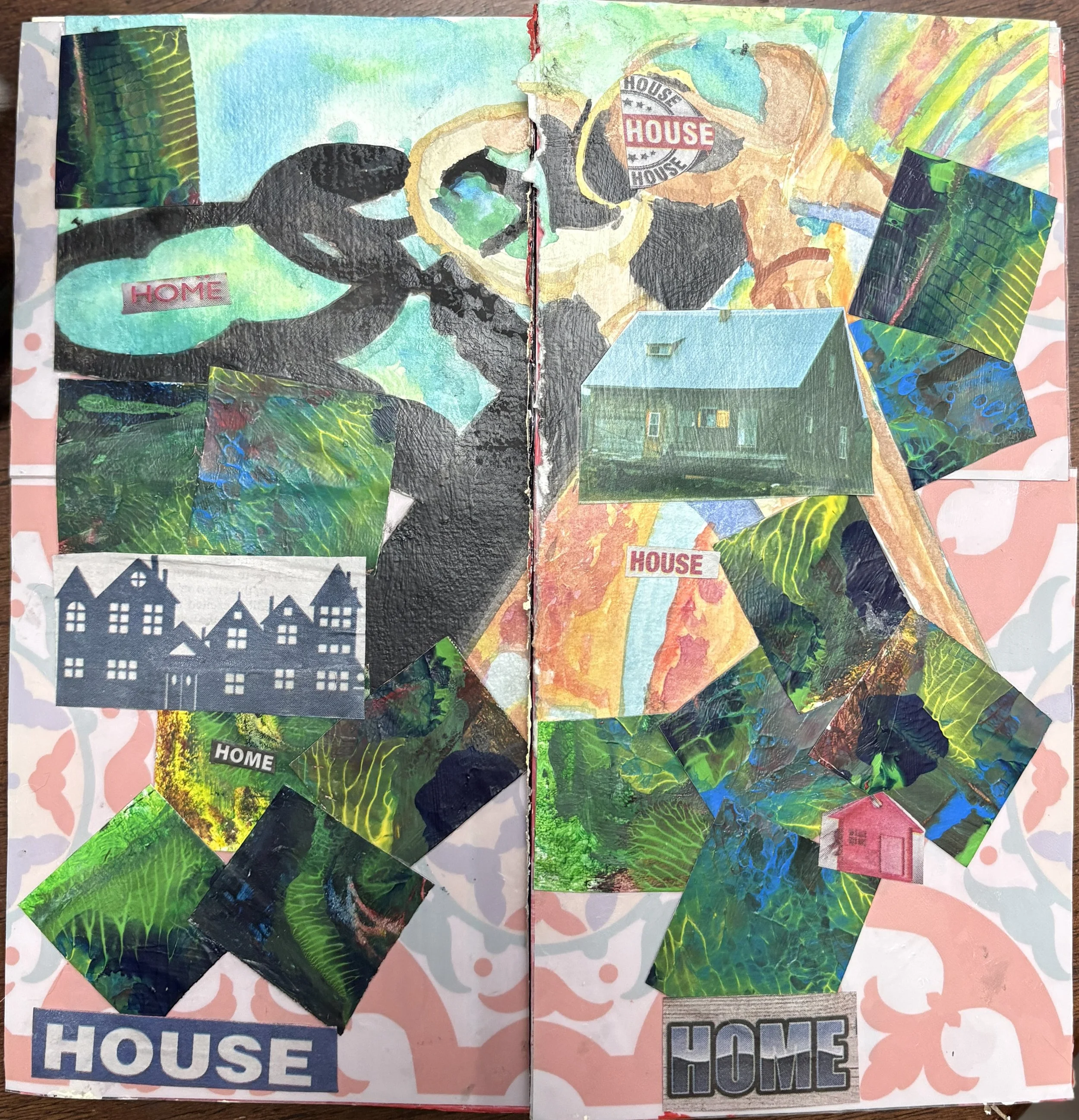
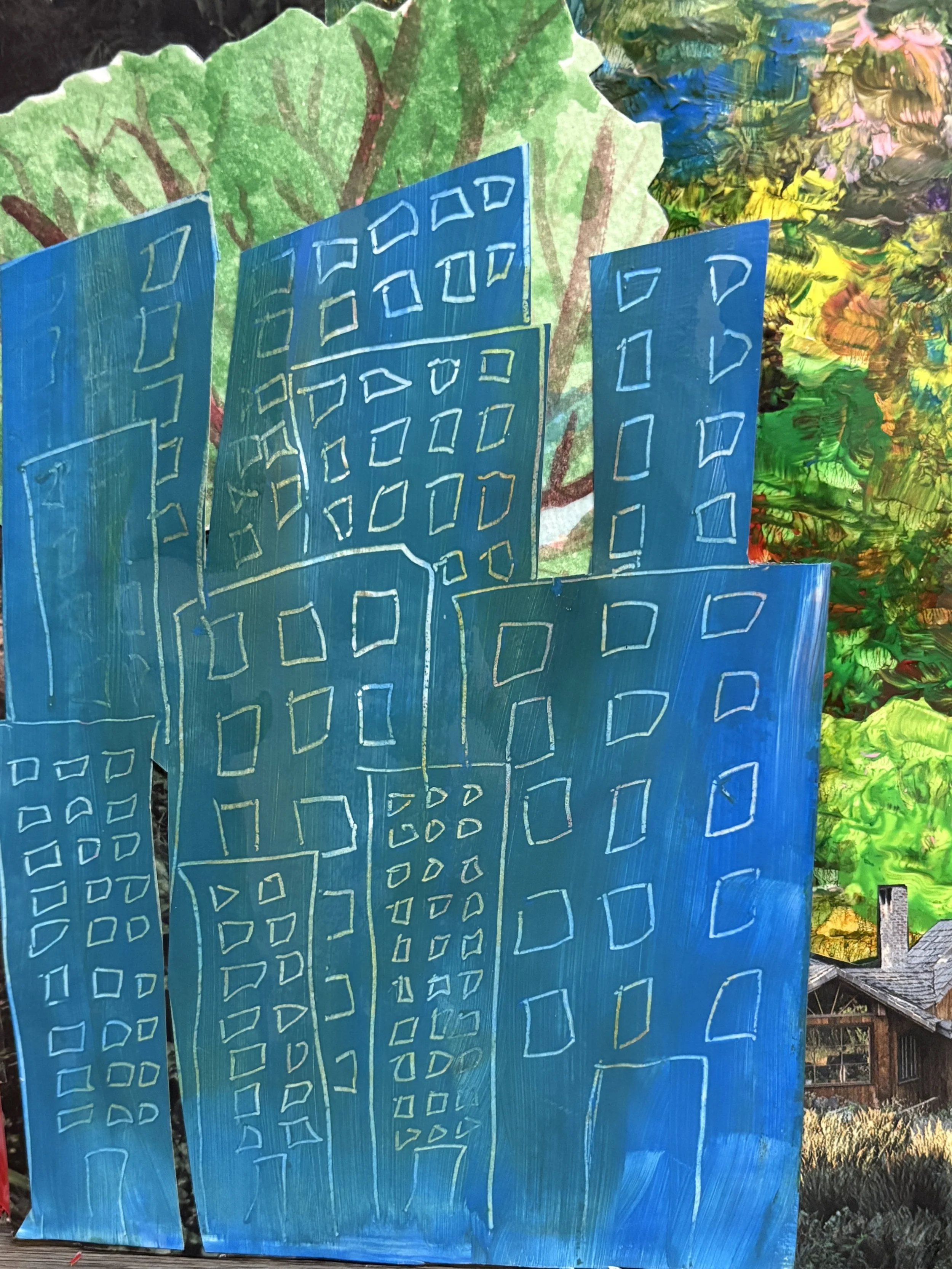
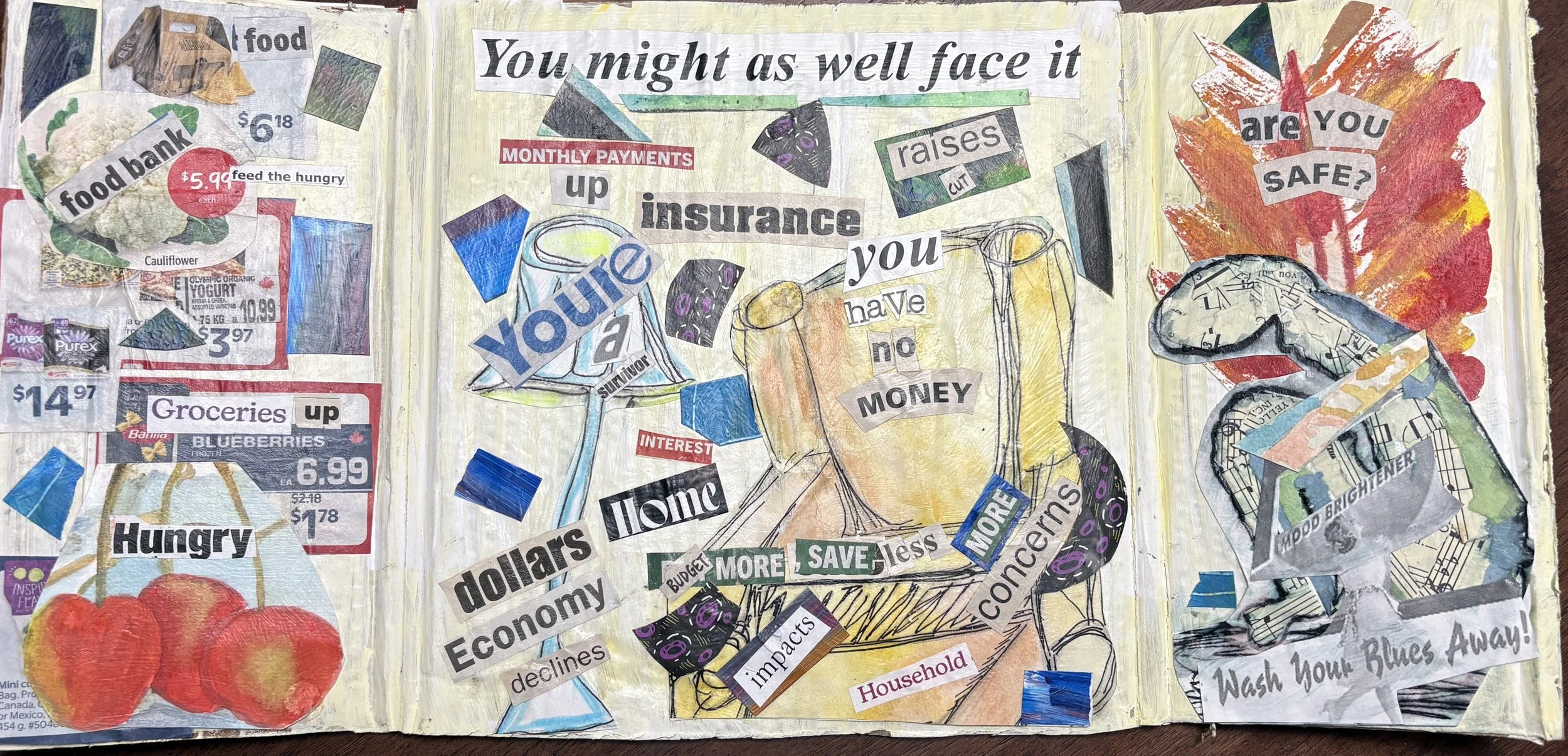
“What You Don’t See”
Collage on cardboard panel display, 10”x10” when closed
In 2017 I was diagnosed with PTSD, following an assault in the workplace. In subsequent years, I was diagnosed with Central Sensitivity Syndrome, an umbrella term for a range of interconnected conditions characterized by heightened sensitivity to pain, fatigue, and stress. Like many people experiencing housing instability who may not be visibly unhoused, the challenges of living with psychosocial and neurological disabilities often go unseen by others. Too often, the result of this is a constant struggle to prove the need for support in a society that misinterprets being housed, regardless of the condition of the space or financial stress involved, as stability and safety.
The current global reality of ongoing climate disasters (fires, floods), alongside newly identified illnesses such as COVID-19 further compound the experiences of those who are both disabled and living in insecure housing situations.
Through intuitive artistic exploration, this piece examines the misconceptions surrounding housing insecurity, drawing on my own lived experience. Using a folding piece of cardboard, I sought to create a piece that gave the appearance of housing stability and safety on the outside, but that when opened up revealed the overwhelming anxiety that occurs over the many barriers that prevent a private space from truly becoming a sanctuary. Any sense of safety is overshadowed by financial, environmental, and other stressors that threaten to push individuals and families past the fine line between housing disparity and becoming unhoused.
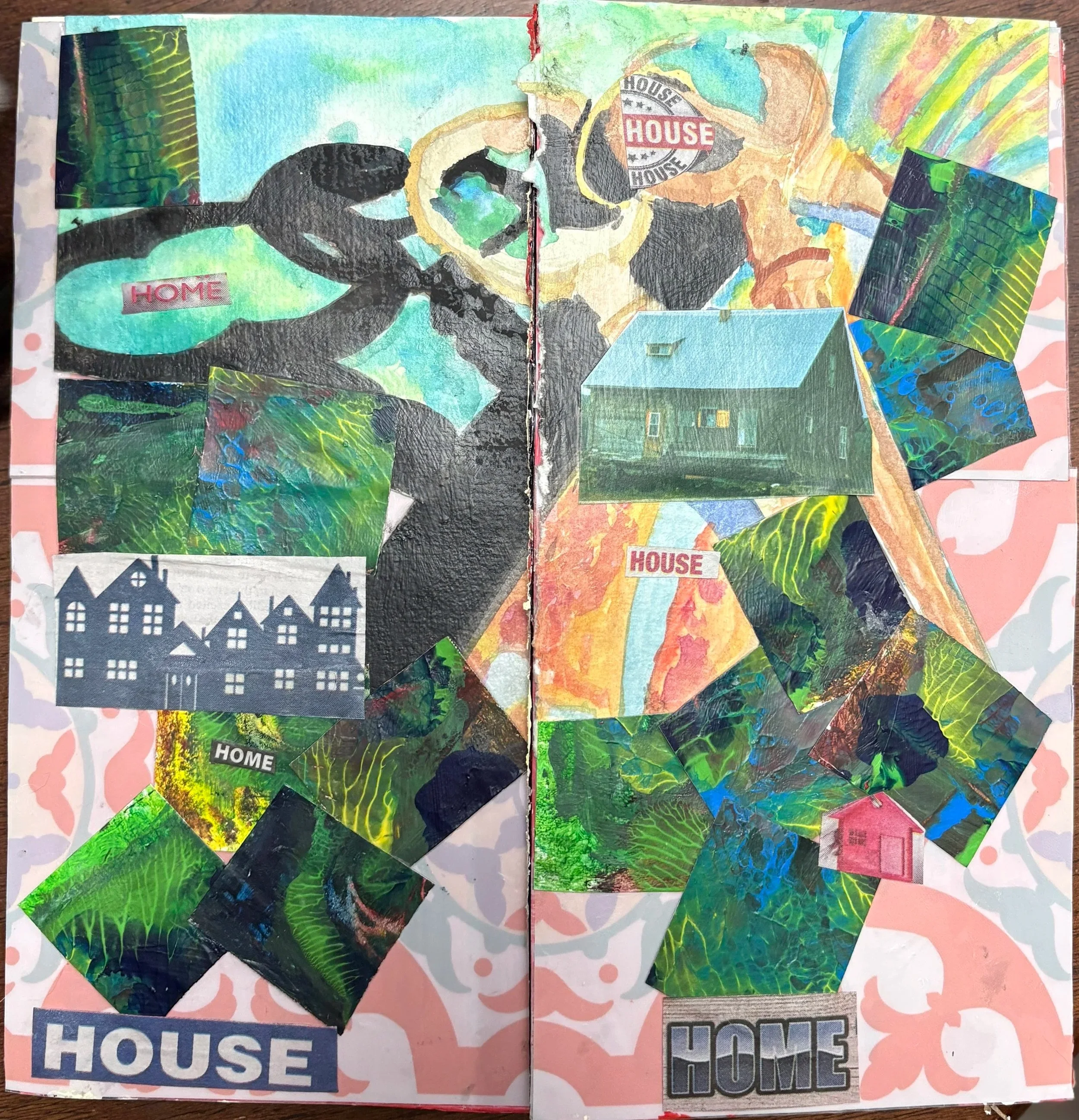
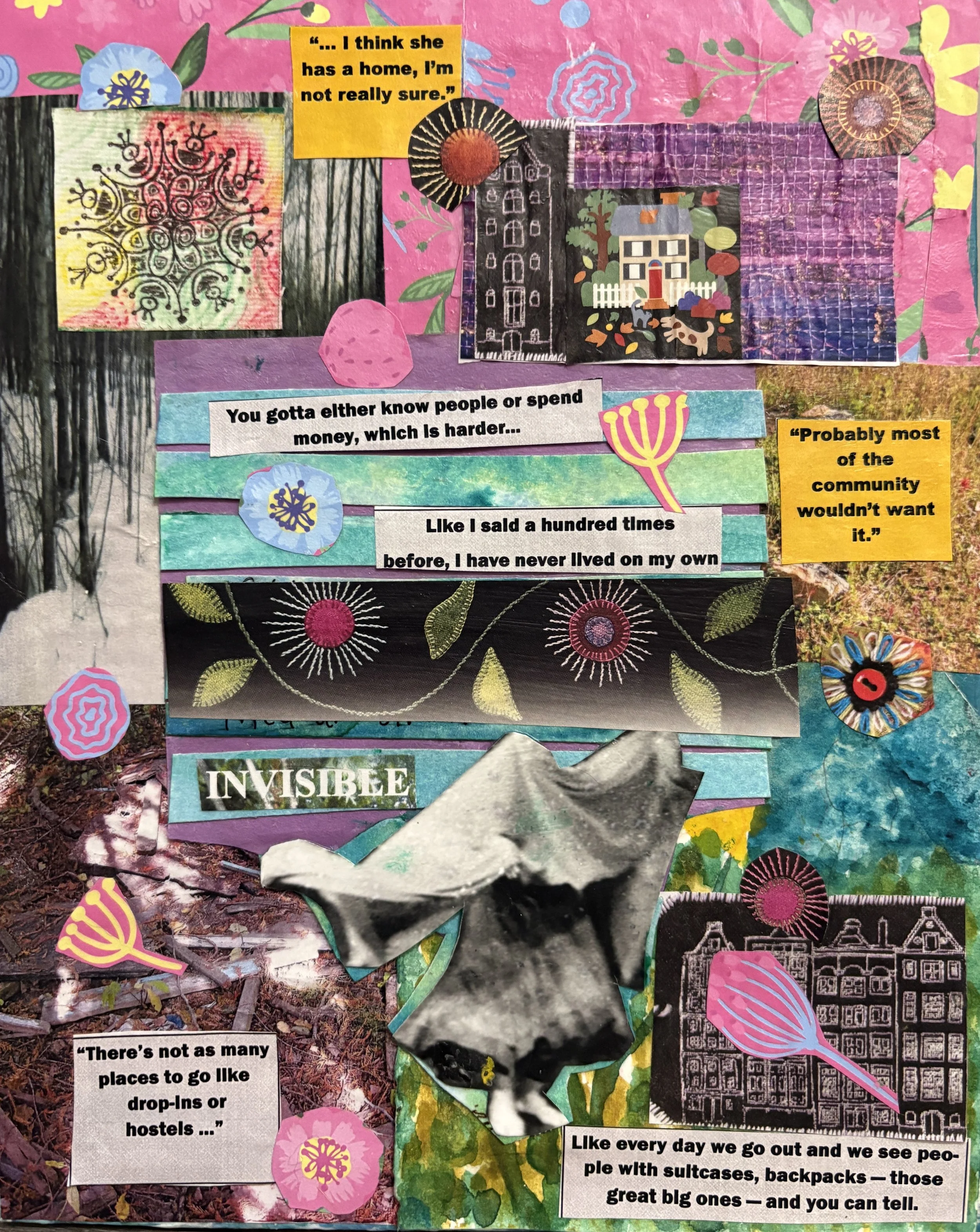
“Introspections on Invisible”
Collage on canvas, 8”x10”
This second piece emerged unexpectedly as I sifted through old art projects for materials I could repurpose. In 2010, I received a Master of Arts in Professional Communication from Royal Roads University.
My thesis research had explored the experiences of marginally housed and unhoused people in rural communities, using Revelstoke, BC as a case study. Reading through the interviews, personal journal entries, and photographs taken by participants acted as a catalyst for quiet introspection.
What emerged was a piece combining photographs and quotes from this research, along with other elements to illustrate how my understanding, along with societal and cultural perceptions of housing insecurity as a spectrum, has evolved over the past 16 years.
My own understanding of housing insecurity evolving from time spent as a frontline outreach worker among unhoused and inadequately housed populations, and then later through my own experiences of housing insecurity and diagnoses of psychosocial and neurological disability.
Meet the Artist: Holly
Hello. My name is Holly. I am a 20-year-old autistic artist currently studying at Kwantlen Polytechnic University (KPU). I hope to one day become an animator and create my own cartoon series for youth and teens. Drawing has always been my thing, and I am starting to share my work publicly.
I am working with KPU to develop my skills in animation and cartoons. I am passionate about art and storytelling, and I especially love cats. I have a cat named Joey and I love to doodle him. Creating animated TV shows is my dream, and I want to tell stories that connect with youth.
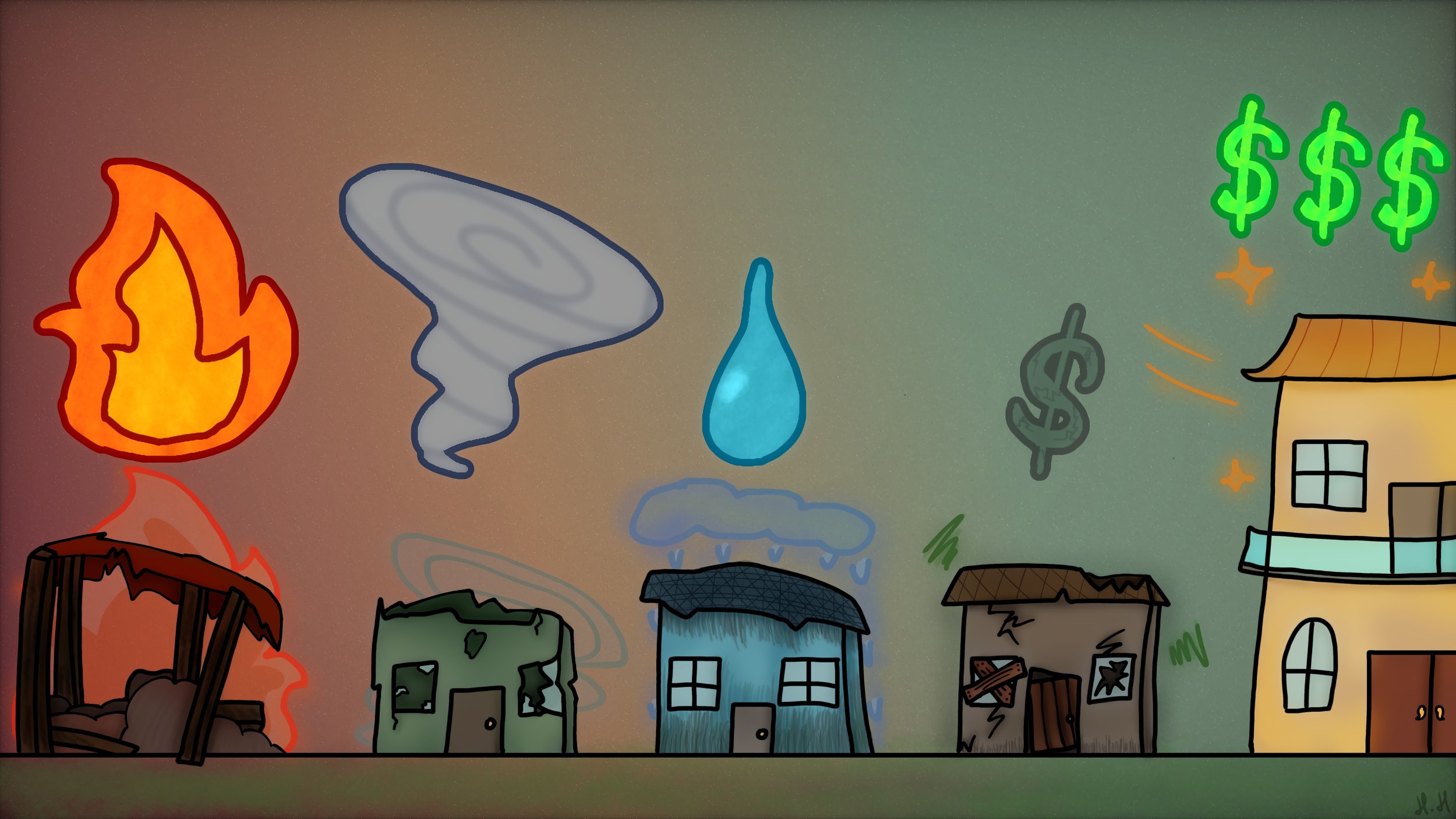
“Five homes”
Digital art
This art piece represents different housing situations around the world, including flooding, fires, tornadoes, earthquakes, and income inequality. Shown here in order are fire, tornado, flood, very low income, and very high income. These are very real problems that people face, and I hope they can be addressed and resolved one day.
In school we have been learning about income inequality and climate change, and how people’s housing can be impacted in ways that feel uncontrollable. None of these homes are accessible. Some may look rich, but who is truly rich nowadays with the wage gap increasing and the middle class shrinking?
What happens if your home burns down or is destroyed by a natural disaster caused by climate change? If you do not have savings, it can be incredibly difficult to recover. People with disabilities or chronic health conditions may need to pay for medications or mobility devices in addition to food cost and rent and other expenses. Losing housing on top of that can be devastating emotionally and financially and then where do you go from there, What do you do?
This piece shows how fragile housing can be and how differently people are affected depending on their income and circumstances.
Artist Profile: Tayler
I’m Tayler. I’m 29, I live with ADHD which is an invisible disability, and I just completed my master’s in clinical counselling. I care deeply about human rights and advocating for people who are navigating systems that were never built for them. I love travel, feminism, and sex positivity, and I’m drawn to conversations that make people think a little deeper about power, autonomy, and desire.
My work blends lived experience with advocacy. I explore housing insecurity, disability, survival, and sexual expression because those themes live in the body and in the system at the same time. I’m interested in the tension between vulnerability and power, fragility and resilience. My art is personal and political, and I cannot separate the two.
“The Plate”
Pottery, 10” round
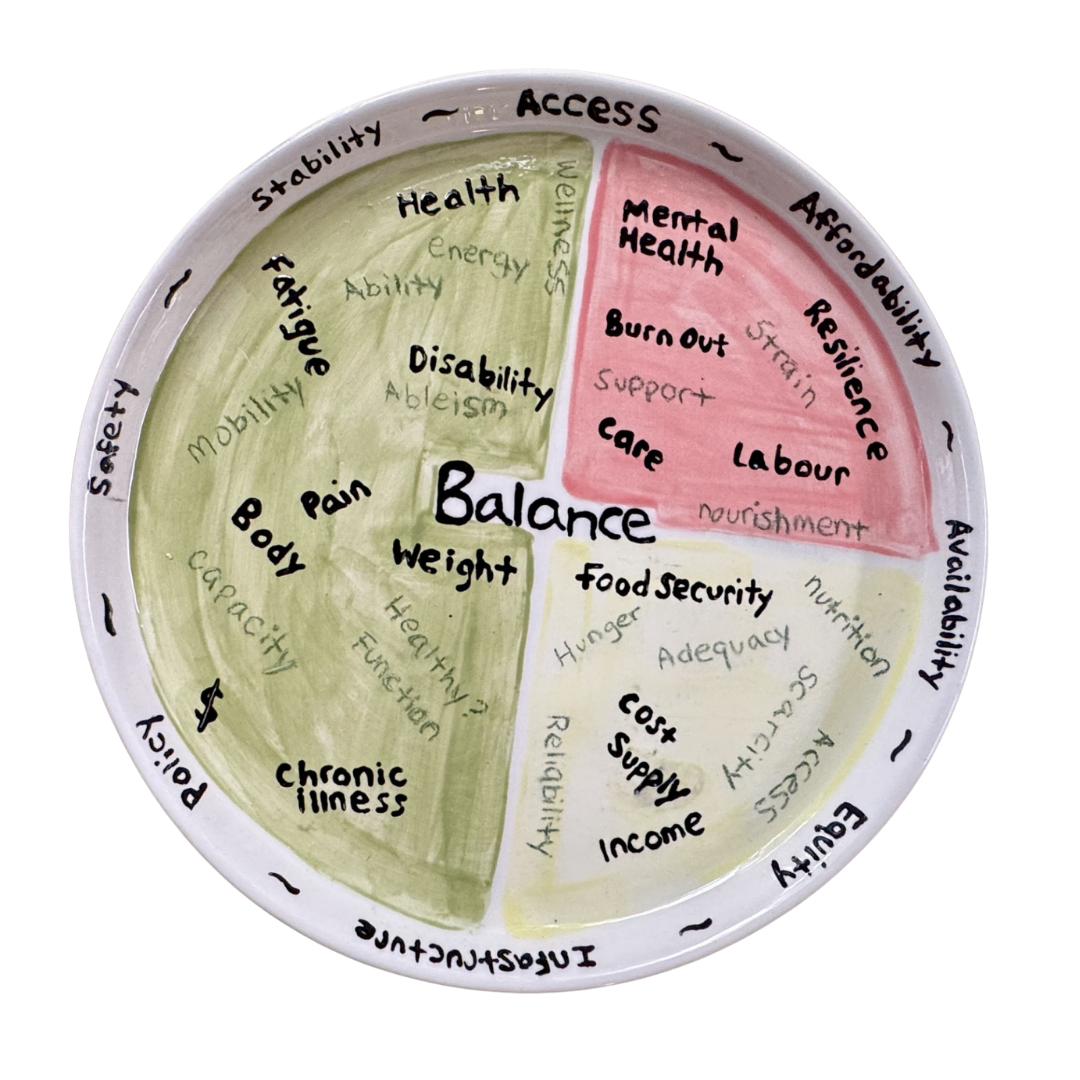
This piece looks like the Canada Food Guide plate. Balanced, colorful, perfect portions. The kind of thing we’re told is healthy and achievable. But I layered it with words like rent, medication, disability, and cost of living because for a lot of people it is not just about filling the plate correctly. It is about whether you can fill it at all.
There is so much pressure to follow the guide as if health is just discipline and effort. The guide does not account for poverty, chronic illness, student debt, or the cost of existing. For some people matching the colors is impossible. For others having a full plate is.
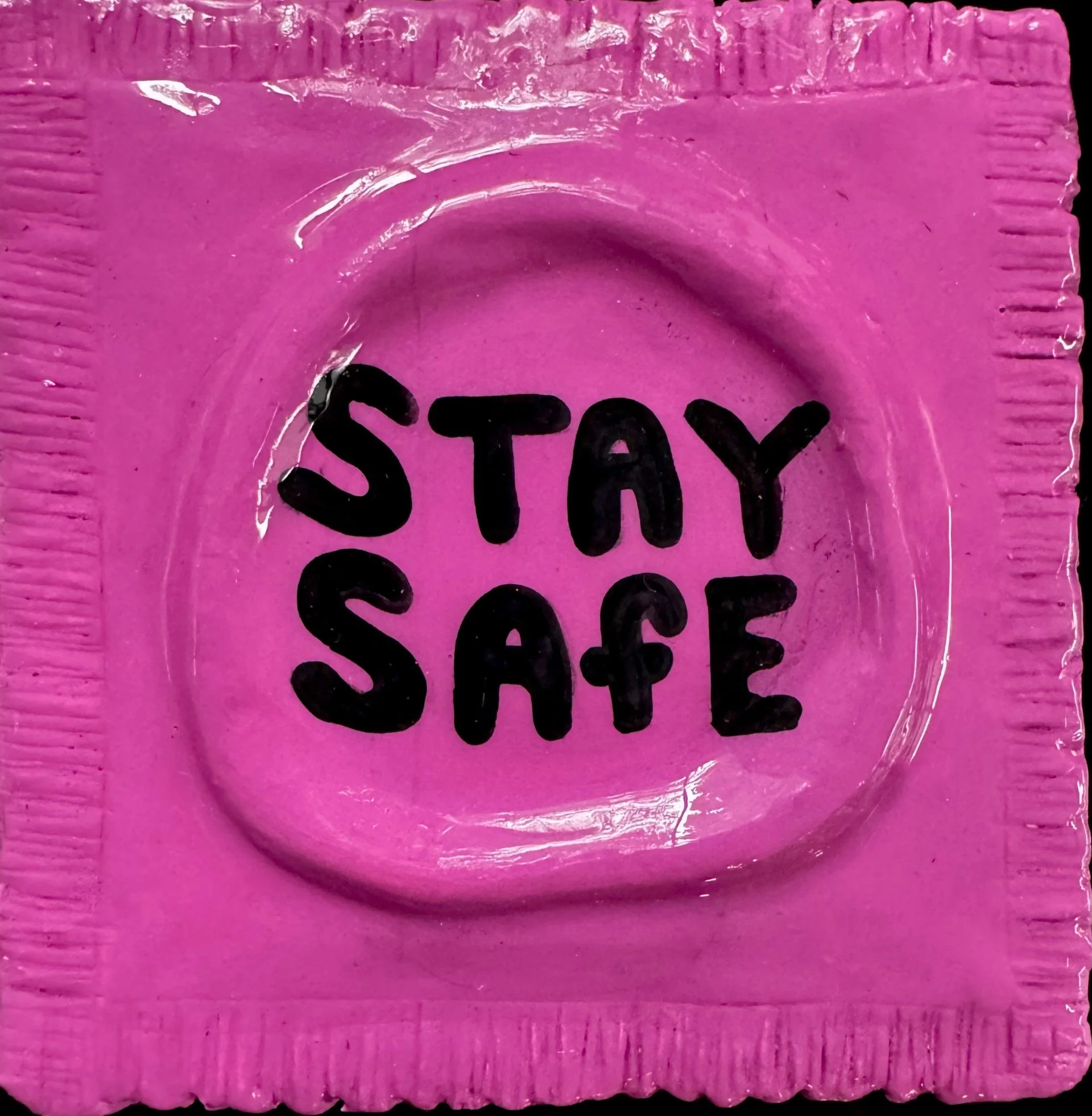
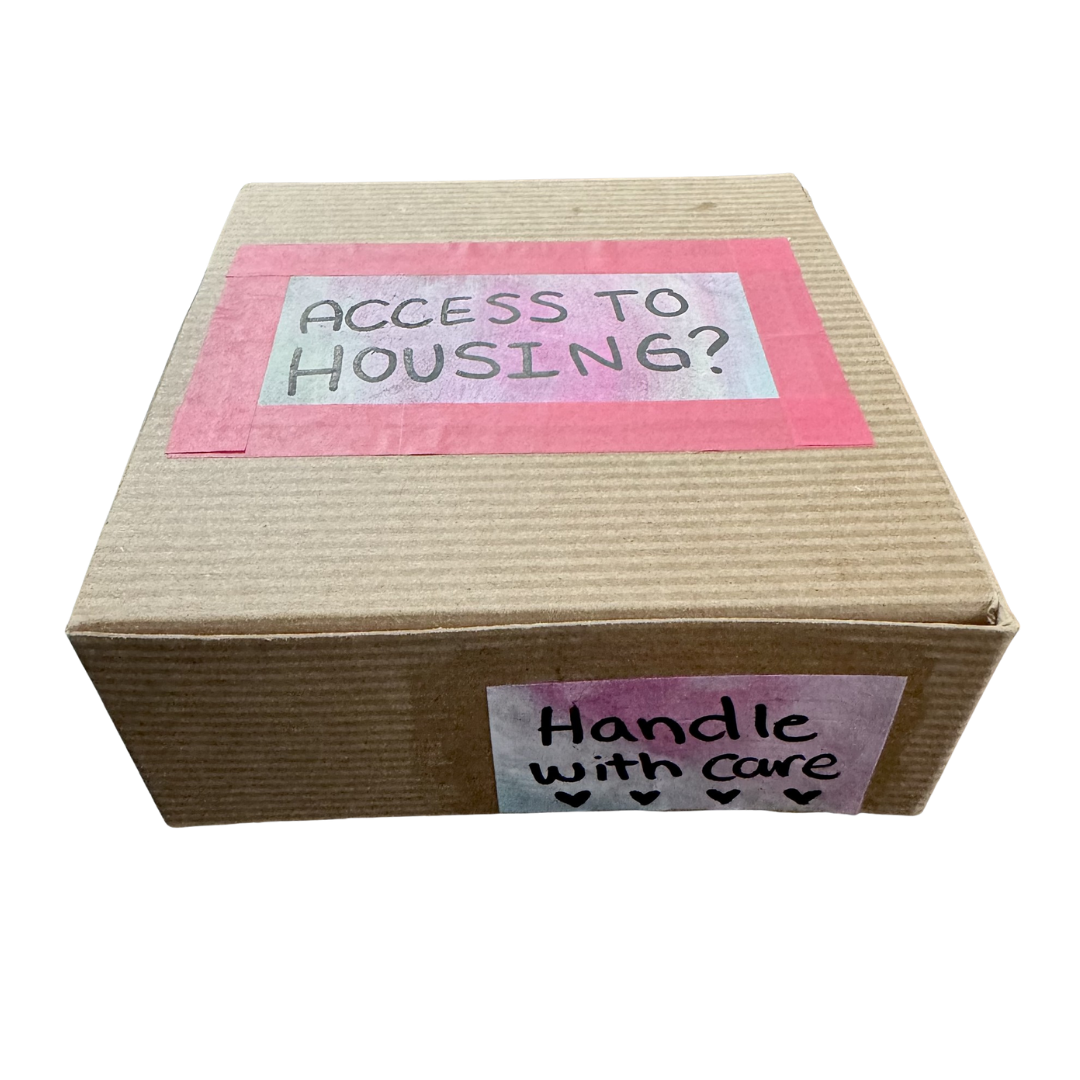
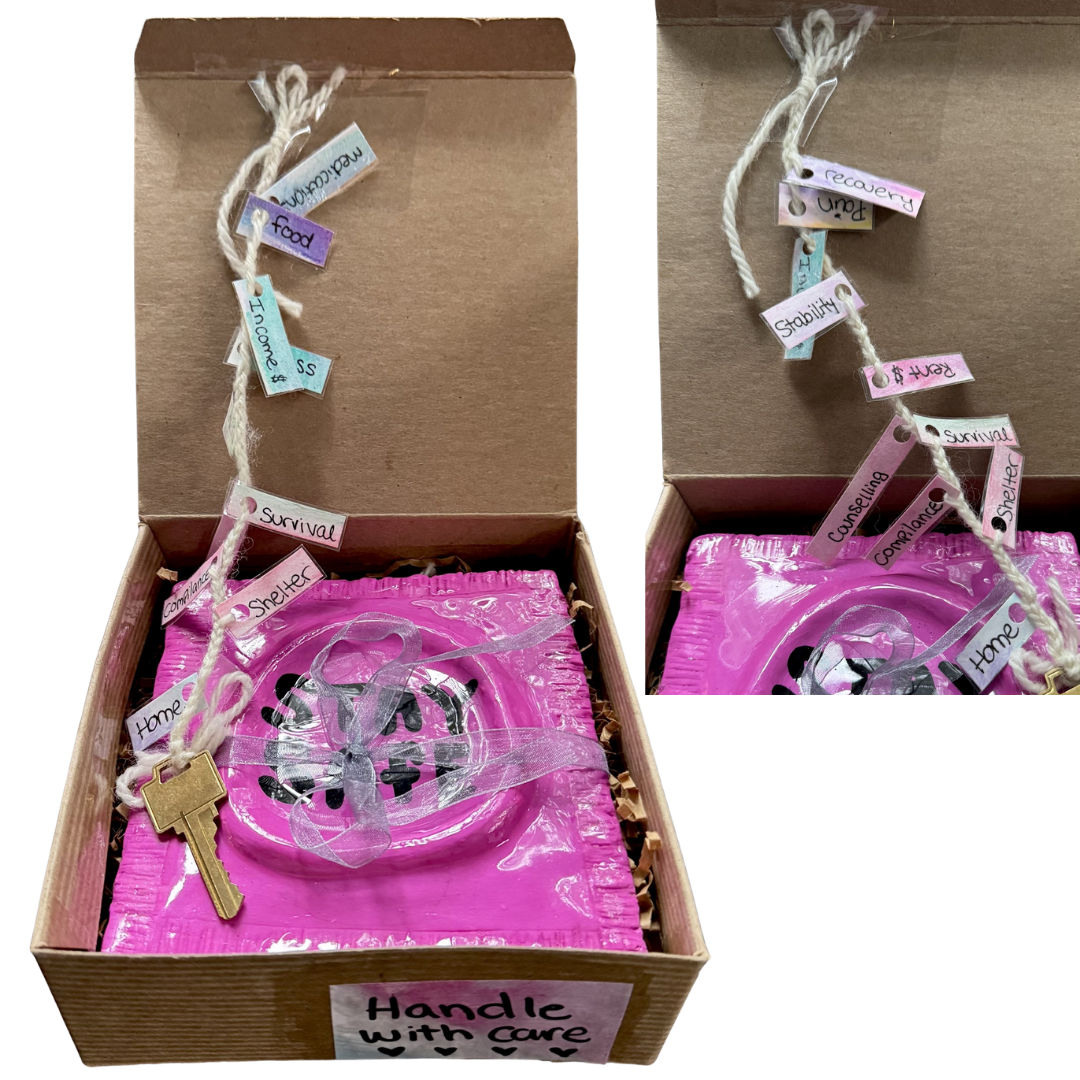
“The Condom”
Clay and mixed medium in box, 6.25”6.25”x2.5”
This condom is intentionally oversized. I wanted it to feel protective but also overwhelming and Heavy.
Protection is not just about sex. It is about housing, safety, and survival. Tied to it are access words and a key because housing is protection. When survival sex work is part of the picture, protection carries weight. It is not light or playful. It can feel like carrying the world. This piece is about that heaviness.
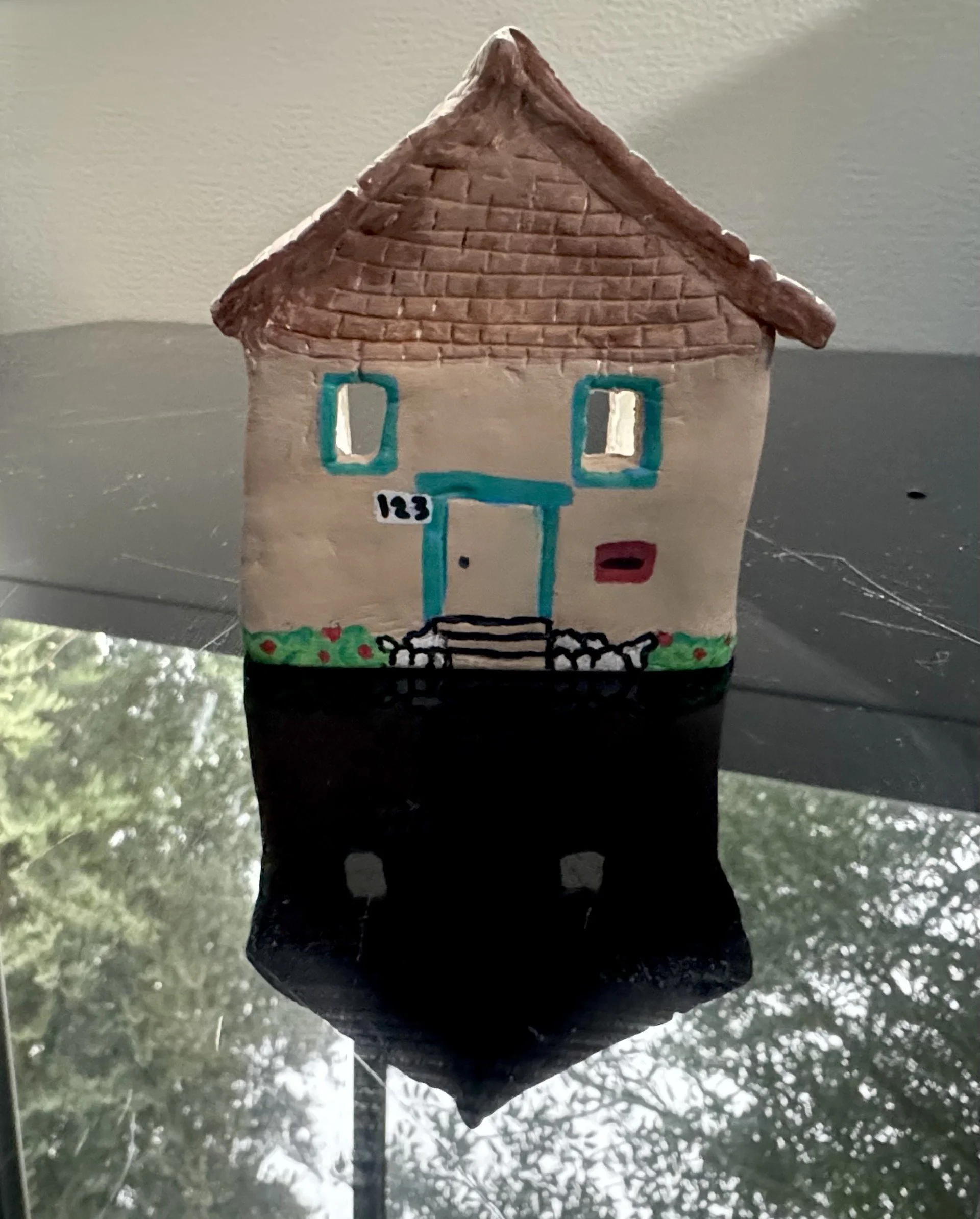
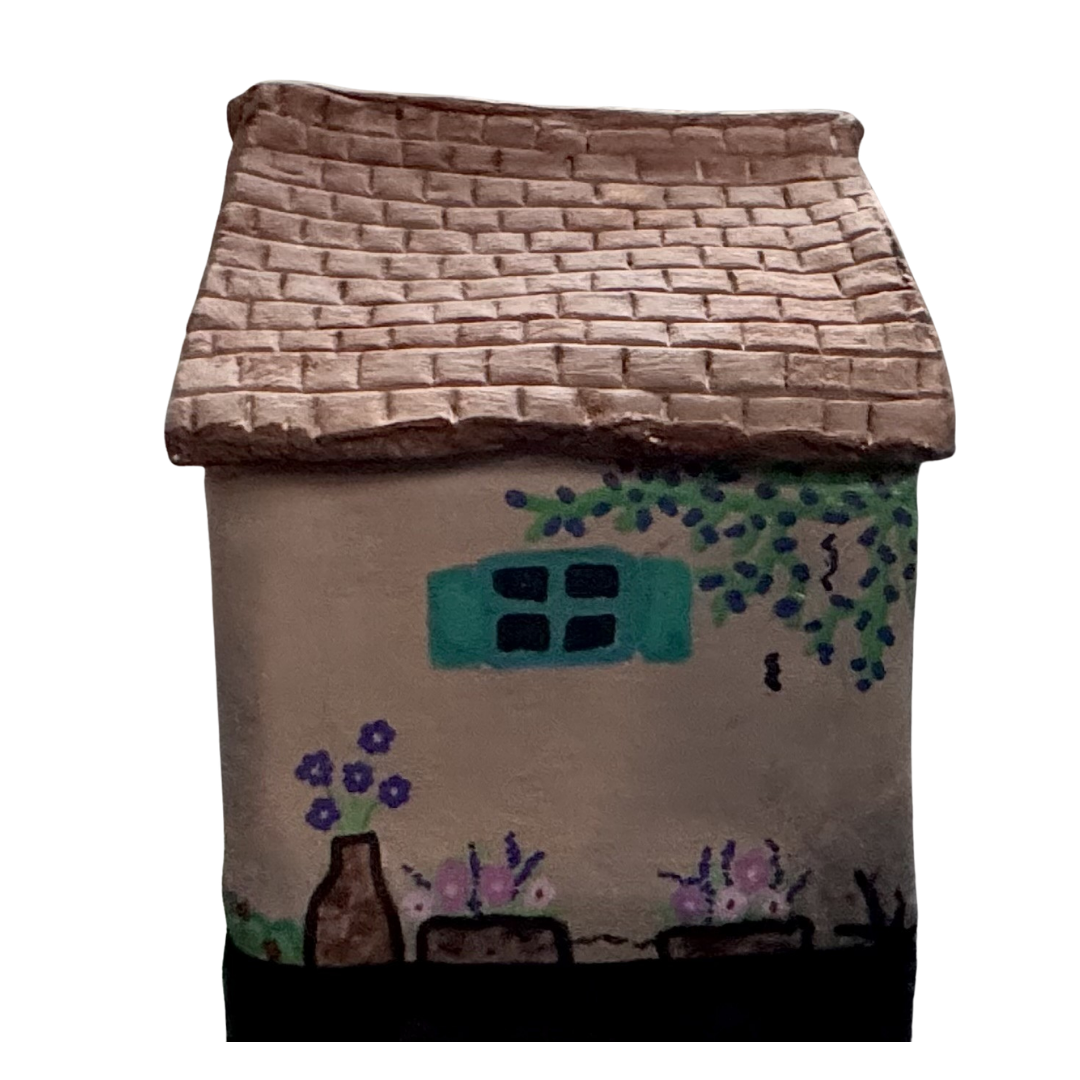
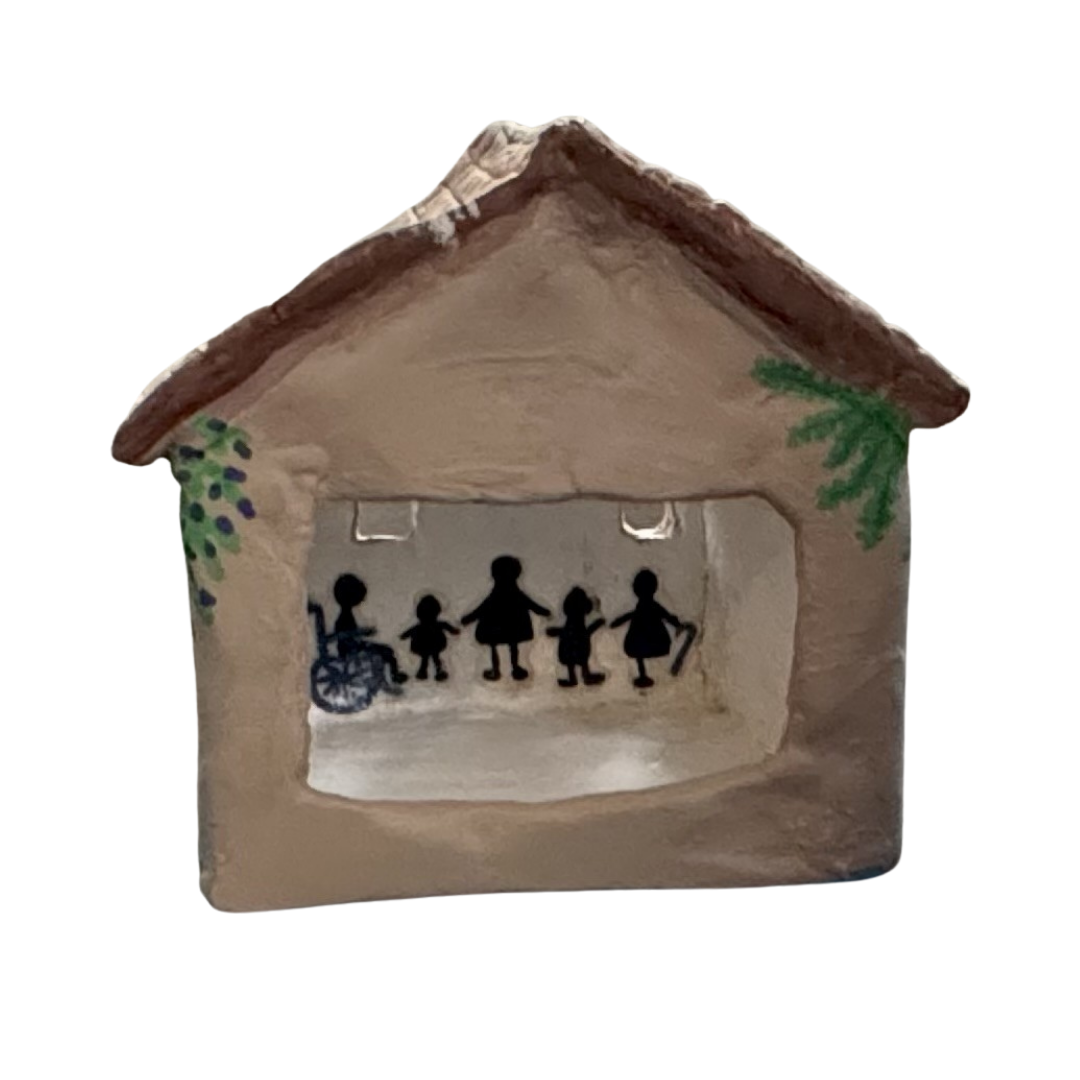
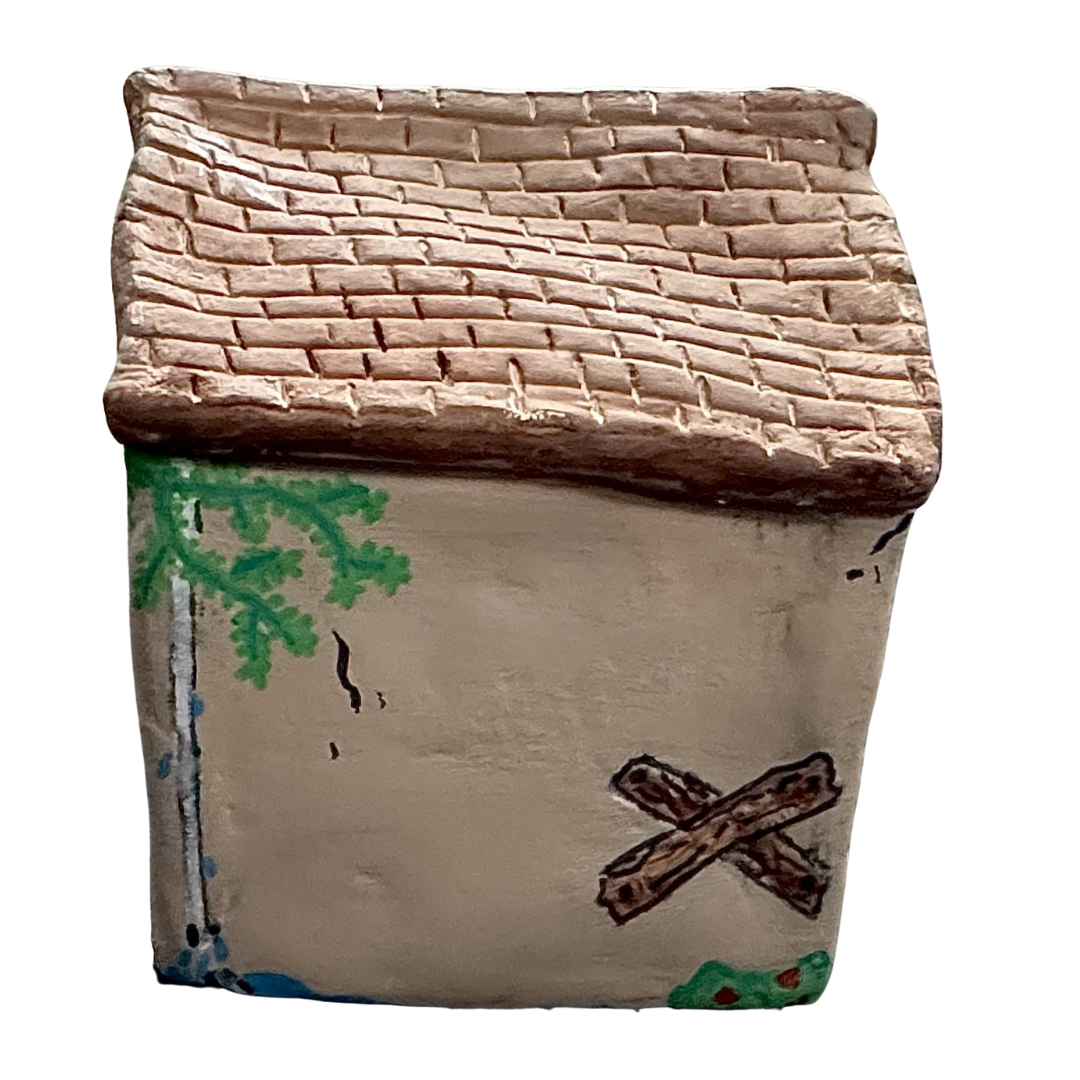
The Portable Home
3D Pottery, 3.5”x3.5”x3”
This house looks cute at first. Flowers. Charm. But when you look closer it is cracked and reinforced with scraps of wood. The drainpipe burst. It is leaking. It is holding itself together.
The high windows are inspired by Woodland’s school where children with disabilities were institutionalized and detained, and where widespread abuse and neglect occurred until its closure in 1996. The windows at Woodlands School were placed so high that children could not see outside, and no one could easily see in. Although the building has been demolished, a memorial garden remains with a preserved windowsill. When I visited, I realized that even at 5'5" (165 cm), I could not see out either and that stayed with me.
In this piece whoever lives inside cannot see out. There is no furniture. No colour. From the outside it looks fine. Inside it is empty. That tension feels important.
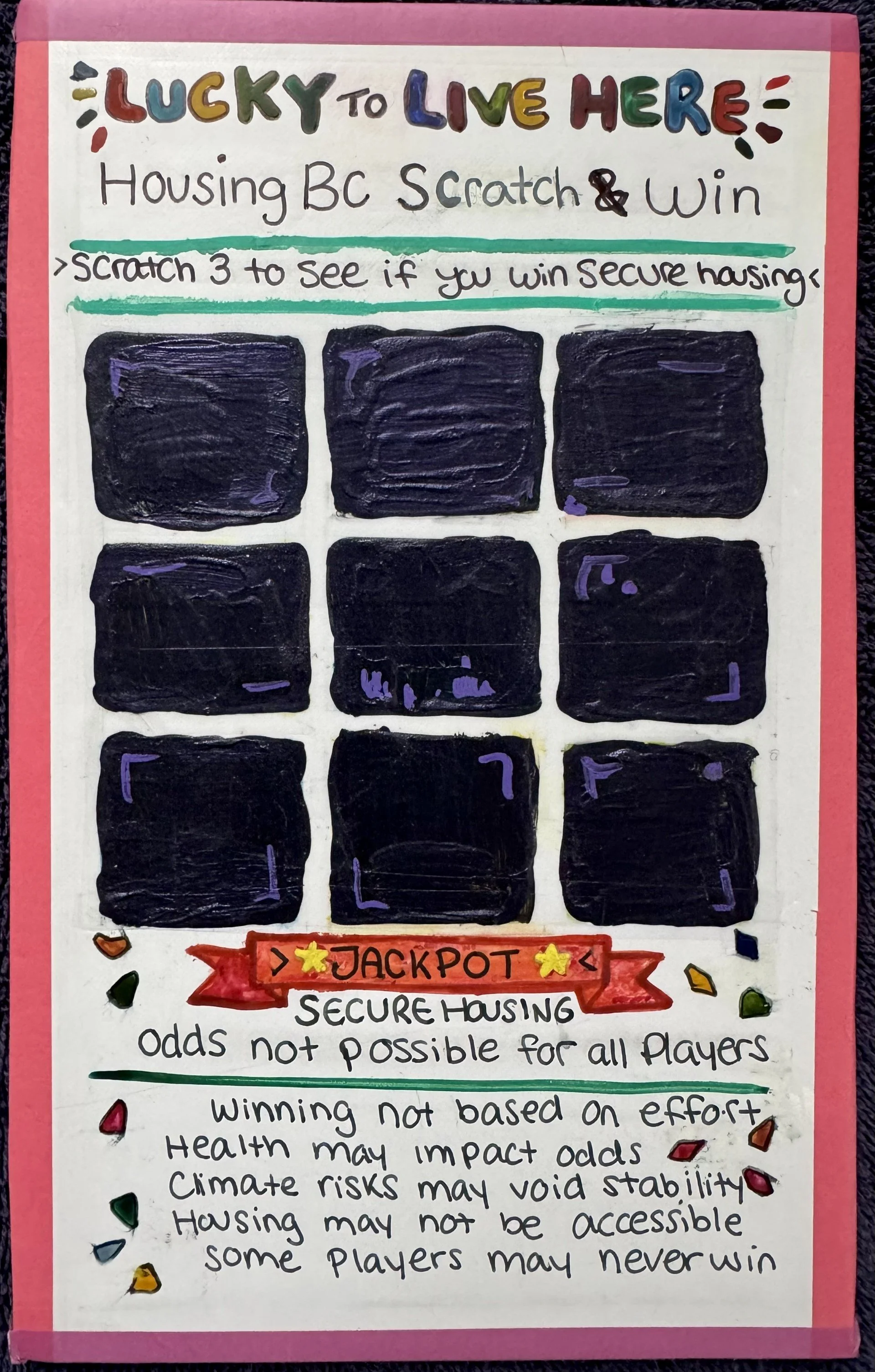
The Lottery Ticket
Mixed medium on board, 6”x9.5”
Housing can feel like a scratch and win ticket. You never know what combination you are going to get. Income, timing, references, luck.
We like to pretend housing is earned. But so often it is luck. Right place, right landlord, right moment. It is a game that should not be a game. Stable housing should not depend on good fortune.
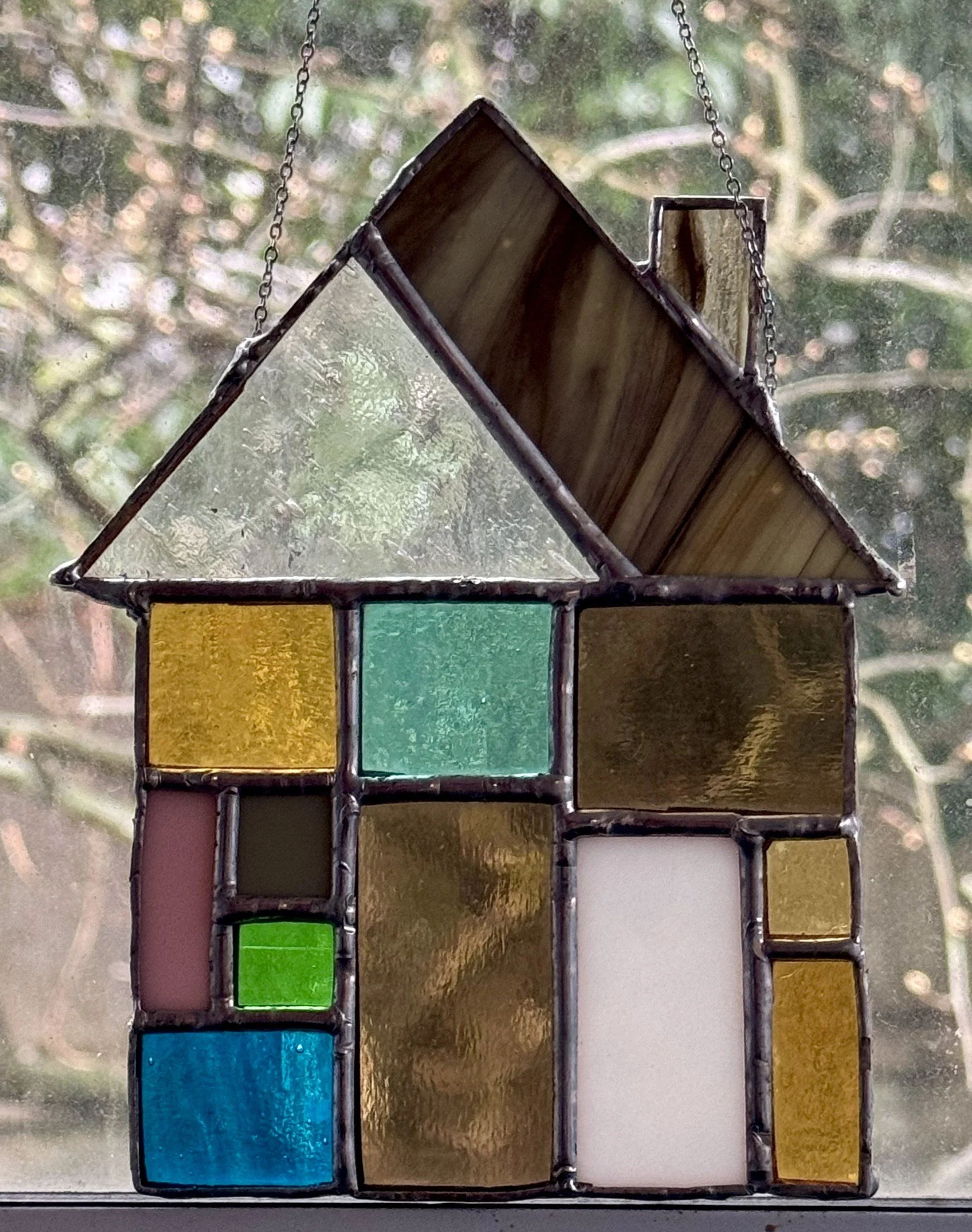
The Stained Glass House
Stained glass, 5”x6.5”
Homes are patchwork. Different influences, different histories, different fractures. I used mixed glass pieces in different colors, opacities, and textures because stability is rarely uniform.
Glass is fragile but also sharp. It lets light through, but it can distort what you see. A home can look beautiful and cohesive from far away, but up close you see the seams. This piece is about fragility and resilience existing at the same time.
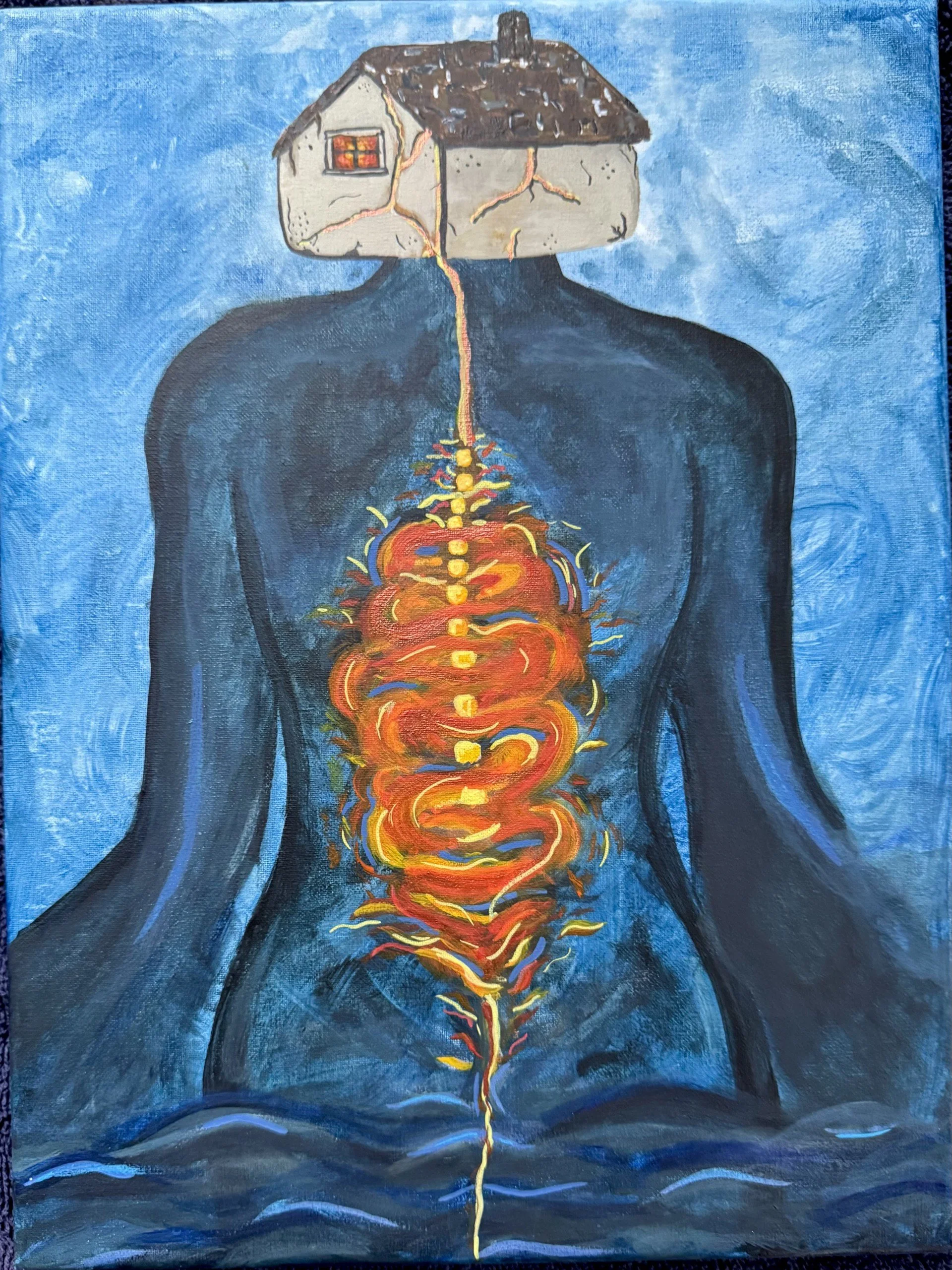
Foundation
Acrylic painting on canvas, 9”x12”
This painting is personal. When I think about housing insecurity I think about how unstable the ground can feel. Using water to create a rocky, stormy foundation. The waves are both external and internal. They represent instability in the world and in the nervous system.
The figure rising from the water carries a house on their shoulders. Their spine is structurally supporting it. The energy in the torso is fiery and electric because that is how survival feels in my body. Hot. Tingly. Radiating up from the stomach to the throat.
It is about the weight of housing living inside the body.
Artist Profile: Tara
Tara is currently a sociology undergraduate at Kwantlen Polytechnic University and hopes to pursue a masters degree in sociology. As an adult with ASD and ADHD, she brings a unique perspective to learning and creativity, navigating processing challenges while embracing a deep love for writing, music, and sound. Poetry and spirituality are important grounding practices in her life and influence how she reflects on the world around her.
Tara is passionate about social issues, particularly housing insecurity and the experiences of people living unhoused. Having experienced housing instability in the past and witnessing addiction struggles within her family, she carries deep empathy for marginalized communities and those navigating complex life circumstances.
Now back at university and building a life she describes as beautiful, Tara continues to explore social issues through writing, reflection, and academic study, advocating for greater understanding and compassion.
The Systemically Dismissed
By Tara Lynn Wall
February 2026
They are the Systemically Dismissed
The selectively minoritized are dehumanized,
disregarded, made obsolete
Does nobody SEE the disabled, undervalued,
rejected peoples on the street?
Cement beds don’t heal,
for real...
Lies about the issue at hand being a lack of
effort
No roofs compiling the hurt
A political stance on who matters
Poverty, the degrading gift shared with the
already oppressed
Manipulation of the racialized, discriminated,
colonized, depressed
Death is acceleration when basic needs become
Vacant
Yet they are a problem? Look down upon as
Vagrants
From mansion to tent, we remain the same (human)
Yet the willfully blind, show destain
for the impoverished society created...
who is really to blame?
Unequal allocation of a human right
Many just making-do, while the others always
making MORE... at what expense
Take their land, their water, their homes
INSTITUTIONALIZE as a disguise for care
Saddened by corporate wealth, greed, abnormal
political norms
Still no homes
Privatized human beings gaslit when they bleed
Without the simplistic requirements that our
sectors deplete
Pain and loneliness seek solitude, pre-isolated
Infectious diseases riddle the unhomed,
self medicated
No home for the needy unless money finds them
Our government sits back and lets corporations
deprive them
Warmth is not the same when socks are wet
Indoors without power is not better yet
Public crisis not individualized blame
It’s insane
Undervalued population with unprovided space
There is no excuse when DISabled people can’t
get a safe place
Inequality creates equal instability
Maslow’s Hierarchy of needs applying only to few
Colonialism encompasses all that they do
What will come next
If there is no where to go, life just becomes more
complex
Government mandates stop them from success
A home: is the only place to call home
Pay attention to our humanity
human rights
are what is right
House the unhomed, feed the hungry, love the
Oppressed by publicizing the private, dismantling the
System. Let the dismissed lead and see society
Blossom?
Artist Profile: Manmeet
Manmeet is a 24-year-old student at Kwantlen Polytechnic University. He is passionate about art, human rights, and advocating for the inequalities people face in everyday life. His work explores social issues, power, and access.
I am an old soul because I do not like social media or AI as I think it causes big problems. I have been an artist for years. He has exhibited his artwork at galleries, including Slice of Life Gallery in Vancouver, where he explored themes of royalty, and debauchery. He has more projects coming up with the gallery this year and continues to use art as a form of advocacy and storytelling.
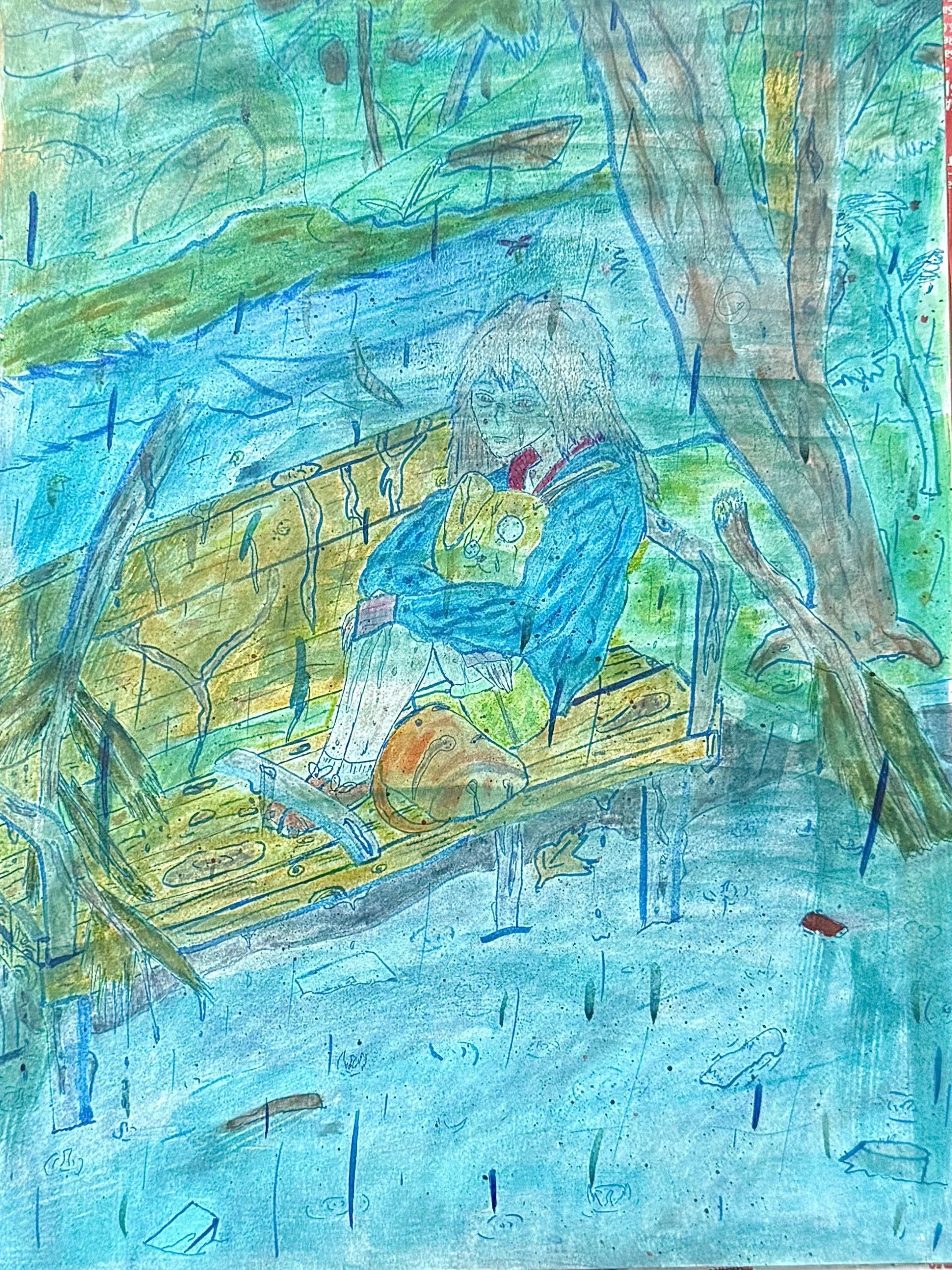
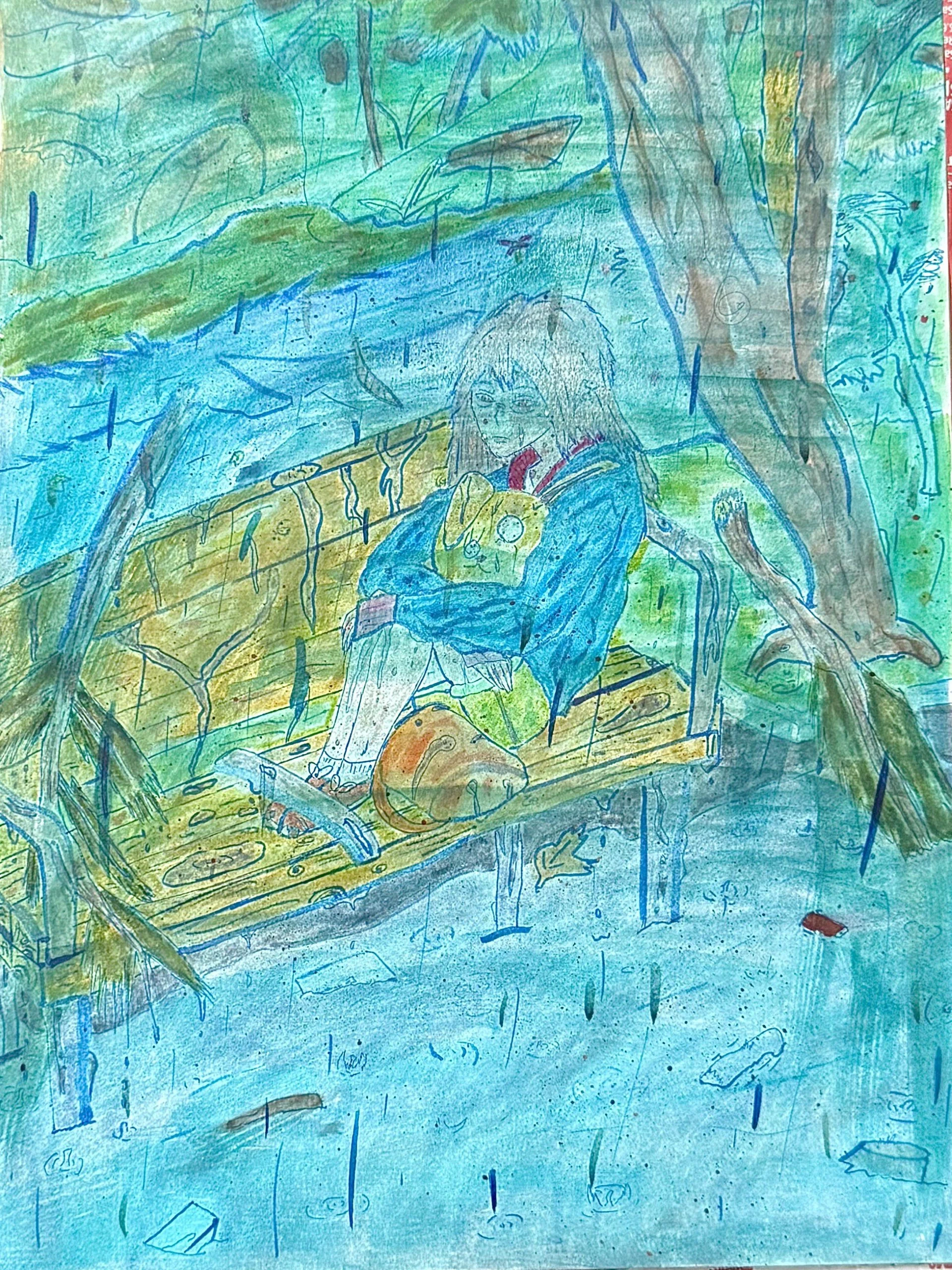
“No Place to Rest”
Mixed media on paper using Indian ink, watercolor, and diluted blue acrylic ink, 9”x12”
This piece shows the effects of climate change and how it impacts people experiencing homelessness. When disasters happen, many people can retreat to their homes and feel some sense of safety. Homeless individuals do not have that option. They are exposed and forced to endure extreme weather with little support.
Homelessness in Canada affects many vulnerable populations, including youth, seniors, and people with disabilities. This work highlights how climate change and housing insecurity are deeply connected.
Artist Profile: Jewelles
Jewelles Smith is a visual artist and writer. After sending her youngest son off to college, Smith experienced a reno-viction in 2018, ultimately having to transplant from the Monashees to the lower mainland. During the pandemic, Smith moved to the Tri-cities, completed her PhD and turned fifty, emerging with the mantra, “say yes” to adventure, and has balanced her work as a JEDI (justice, equity, diversity, and inclusion) consultant with travel and creative passions. Her art will take you through an experiential journey, exploring themes of social justice, human rights, disability, and child loss. Smith’s paintings layer vibrant oil colours, images, text printmaking, and found objects on canvas. Currently, she is exploring the meaning of “home” in the context of the housing crisis, climate emergencies, and all the diversity of human experience and need.
-
I have been engaged in research on housing and disability for nearly two decades. As a disabled person, I have my own story and experience of housing insecurity that includes homelessness, inaccessibility, affordability, and safety barriers.
When I am interviewing individuals about their housing experiences, I am often balancing my own emotions about the world we live in. As both a researcher and an artist, I am able to turn to my art materials to explore these concepts.
-
Due to an unexpected health hiccough during the coordination of this project, I was unable to complete a number of the pieces I am currently in the middle of (as of March 15, 2026). I will add them once they are ready.
“Holding it All”
Charcoal and watercolour on paper 12”x18”
During displacement, whether due to climate or other emergencies, including reno-viction, rent increases, or other factors, it feels like you are holding it all in your arms. Stumbling through bureaucracy and an endless series of unfortunate events.
All you want is a place to plant roots and build community.
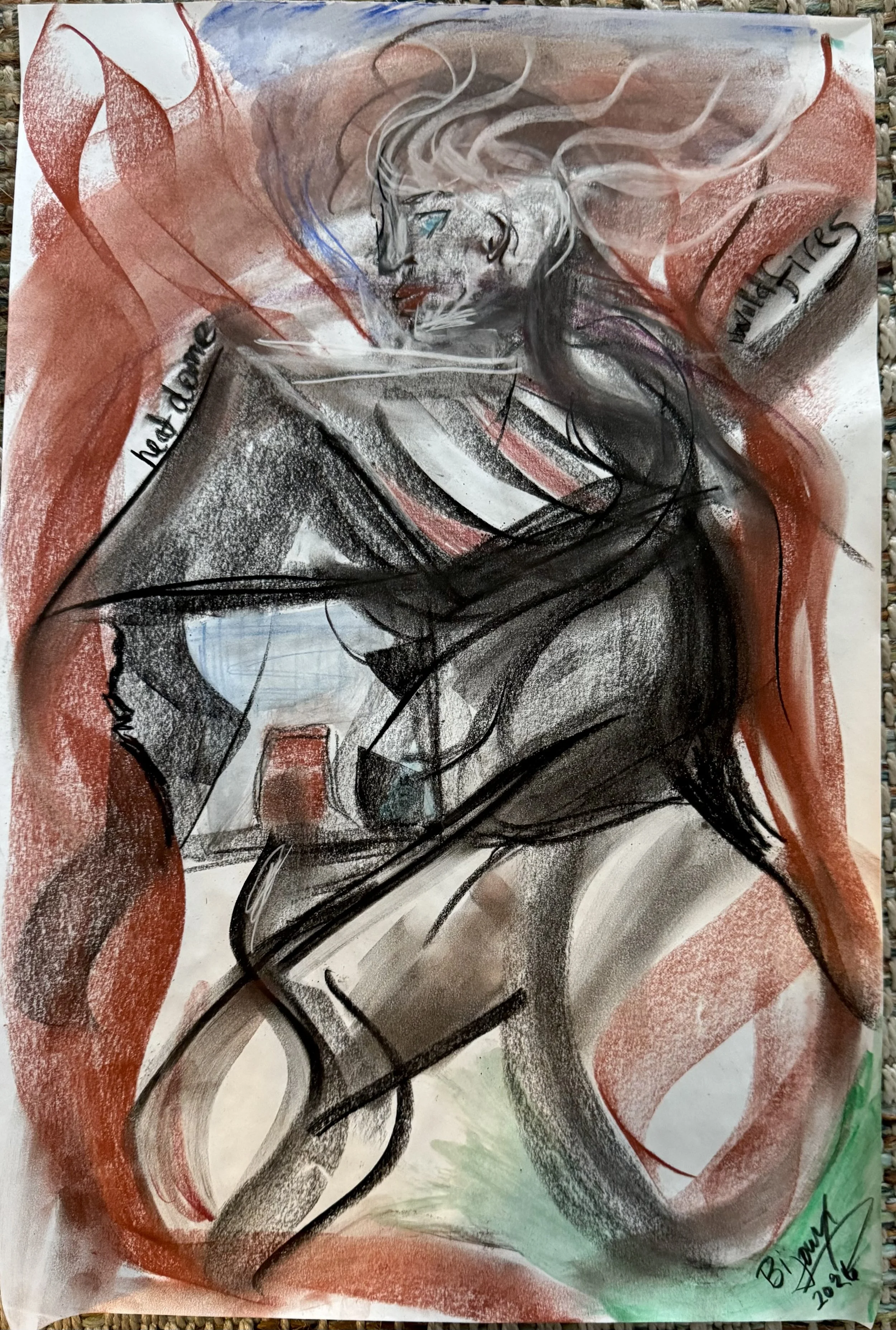
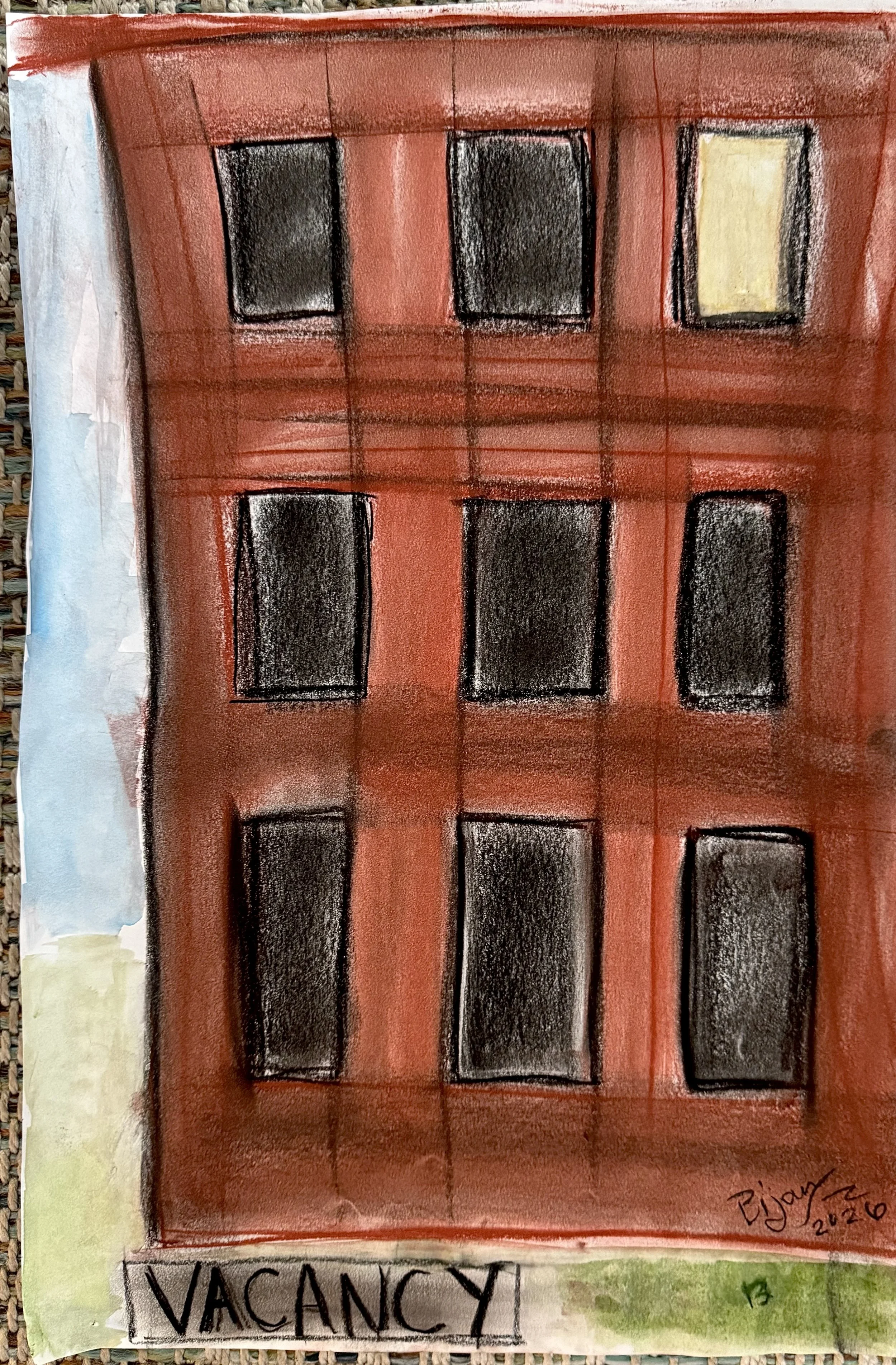
“Vacancy, with Conditions”
Charcoal and watercolour on paper, 12”x18”
Often, the housing that is available is inaccessible, even dangerous. Disability pensions, both provincial and federal do not keep up to the actual cost of home. Many disabled tenants make decisions not based on any real choice, balancing how much they can push their accessibility and safety needs with other factors, including cost, access to bus routes or medical clinics.